Business Intelligence Exercises: Practice Real-World BI Skills for Better Decision Making
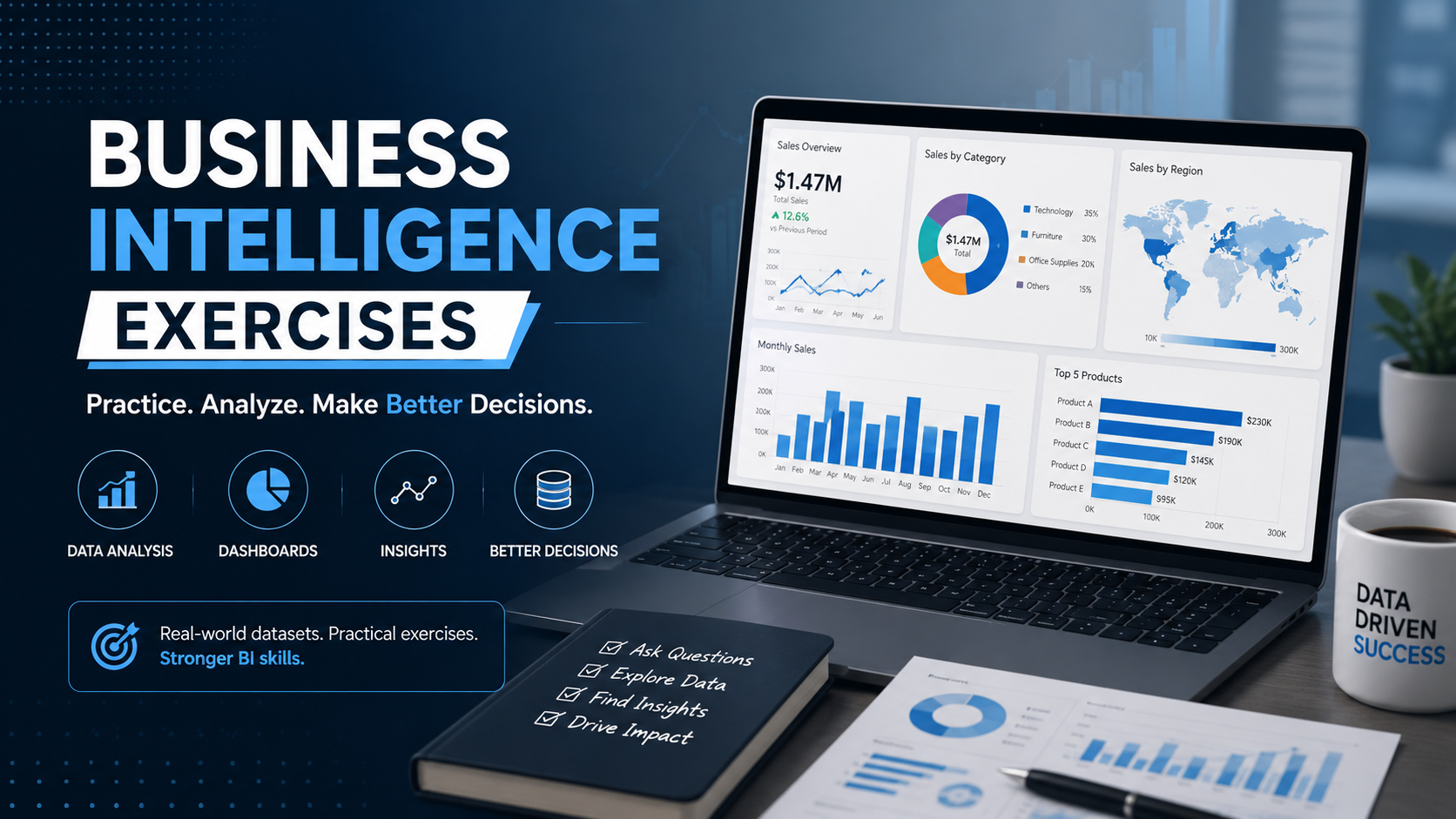
Business intelligence (BI) has become one of the most valuable skill sets in the modern data-driven world. Organizations no longer rely only on intuition; instead, they depend on structured data analysis, dashboards, and insights to guide their decisions. However, learning BI is not just about understanding theory—it requires consistent practice through Business Intelligence Exercises that simulate real-world scenarios.
This article provides a complete, human-written, and practical guide to BI learning through structured exercises. Whether you are a beginner, an aspiring data analyst, or an experienced professional, these exercises will help you strengthen your analytical thinking, improve reporting skills, and make better business decisions.
Understanding Business Intelligence Exercises and Their Importance
Business Intelligence Exercises are structured tasks or real-world scenarios designed to help learners practice data analysis, reporting, visualization, and decision-making skills using BI tools such as Power BI, Tableau, Excel, or SQL-based platforms. These exercises simulate actual business problems where data must be collected, cleaned, analyzed, and turned into actionable insights.
The importance of these exercises lies in their ability to bridge the gap between theoretical knowledge and real-world application. Many learners understand BI concepts but struggle when working with actual datasets. Exercises help solve this problem by providing hands-on experience. For example, instead of simply learning what a dashboard is, a learner builds one using sales data to identify trends and patterns.
Moreover, BI exercises improve critical thinking. They teach you how to ask the right questions: Why are sales dropping in a particular region? Which customer segment is the most profitable? What factors influence revenue growth? By practicing consistently, learners develop the ability to think like business analysts, not just data users.
Setting Up Your Environment for Business Intelligence Practice
Before starting any Business Intelligence Exercises, it is essential to set up a proper working environment. This ensures that you can focus on learning rather than struggling with tools or data access issues. A typical BI setup includes tools like Microsoft Excel, Power BI Desktop, Tableau Public, or SQL databases such as MySQL or PostgreSQL.
Excel is often the starting point for beginners due to its simplicity and accessibility. It allows users to perform data cleaning, pivot table analysis, and basic visualization. Power BI and Tableau are more advanced tools that help in creating interactive dashboards and reports. SQL, on the other hand, is crucial for extracting and managing large datasets from databases.
Along with tools, you also need sample datasets. Many free datasets are available online related to sales, finance, marketing, healthcare, and e-commerce. These datasets form the foundation of your exercises. Once your environment is ready, you can start performing structured BI tasks like data cleaning, visualization, and reporting without interruptions.
Data Cleaning Exercises for Strong Analytical Foundations
Data cleaning is one of the most important steps in any BI process. Without clean data, even the most advanced analysis can produce misleading results. Business Intelligence Exercises focused on data cleaning help you understand how to prepare raw data for meaningful analysis.
In these exercises, you typically work with messy datasets that include missing values, duplicate records, incorrect formatting, and inconsistent entries. Your task is to identify and fix these issues. For example, you may be given a sales dataset where some dates are missing or product names are inconsistent (e.g., “Laptop” vs “laptop”). You must standardize and clean the data.
These exercises teach attention to detail and improve your ability to detect errors that could affect business decisions. You also learn how to handle missing values—whether to remove them, replace them with averages, or estimate them based on patterns. Over time, you develop a strong foundation in preparing data for deeper analysis.
Data Visualization Exercises for Better Insights
Data visualization is a core component of Business Intelligence. It involves transforming raw data into visual formats such as charts, graphs, and dashboards. BI exercises in this area help you understand how to present data in a way that is easy to interpret.
In these exercises, you may be asked to create bar charts for sales comparison, line graphs for trend analysis, or pie charts for market share distribution. The goal is not just to create visuals but to choose the right type of visualization for each dataset.
For example, a line chart is best for showing changes over time, while a bar chart is ideal for comparing categories. Through repeated practice, you learn how visual representation can significantly influence decision-making. You also develop storytelling skills with data, which is highly valuable in business environments.
Advanced exercises may include building interactive dashboards where users can filter data by region, product, or time period. This enhances your ability to create professional BI reports.
SQL-Based Business Intelligence Exercises
SQL plays a critical role in Business Intelligence because most business data is stored in relational databases. SQL-based BI exercises help you learn how to extract, manipulate, and analyze data efficiently.
These exercises typically involve writing queries to retrieve specific information. For example, you might be asked to find total sales per region, identify top-performing products, or calculate monthly revenue growth. You will use commands like SELECT, JOIN, GROUP BY, and WHERE to complete these tasks.
As you progress, exercises become more complex. You may need to combine multiple tables, filter large datasets, or create subqueries for deeper analysis. This helps you understand how real-world business systems work.
SQL exercises also improve logical thinking. You learn how to break down a business problem into smaller parts and translate it into structured queries. This skill is essential for any BI professional working with databases.
Dashboard Building Exercises for Business Reporting
Dashboards are one of the most powerful tools in Business Intelligence. They provide a visual summary of key business metrics in a single view. BI dashboard exercises focus on creating interactive and insightful reports using tools like Power BI or Tableau.
In these exercises, you typically work with business scenarios such as sales performance tracking, customer behavior analysis, or financial reporting. Your task is to design a dashboard that highlights key performance indicators (KPIs) clearly.
For example, a sales dashboard may include total revenue, monthly growth, top-selling products, and regional performance. You must ensure that the dashboard is not only visually appealing but also easy to understand and interactive.
These exercises help you develop design thinking skills. You learn how to structure information, choose appropriate visuals, and ensure that decision-makers can quickly understand insights without technical knowledge.
Predictive Analysis Exercises for Advanced BI Skills
Predictive analysis is an advanced area of Business Intelligence that focuses on forecasting future trends using historical data. BI exercises in this category help learners understand how to use data patterns for prediction.
In these exercises, you may analyze past sales data to predict future revenue or study customer behavior to forecast churn rates. While basic predictions can be done using Excel or Power BI, more advanced exercises may involve Python or machine learning models.
These exercises teach you how to identify patterns, understand correlations, and apply statistical methods. For example, you may discover that sales increase during specific seasons or that certain customer segments are more likely to make repeat purchases.
Predictive BI exercises are especially valuable for strategic decision-making. Businesses rely on forecasts to plan budgets, marketing campaigns, and inventory management.
Real-World Case Study-Based BI Exercises
Case study-based exercises are among the most effective ways to learn Business Intelligence. These exercises simulate real business problems and require end-to-end analysis.
For example, you may be given a scenario where a retail company is experiencing declining sales. Your task is to analyze data, identify potential causes, and provide actionable recommendations. This involves data cleaning, visualization, and interpretation.
Another case study might involve analyzing customer feedback data to improve product quality or studying website traffic data to increase conversions.
These exercises help you think like a business consultant. Instead of just working with numbers, you focus on solving real problems. You also learn how to communicate insights clearly to stakeholders.
Common Mistakes in Business Intelligence Exercises and How to Avoid Them
While practicing BI exercises, learners often make common mistakes that can slow down their progress. One major mistake is focusing too much on tools instead of understanding the data. Tools are important, but without analytical thinking, they are useless.
Another common mistake is ignoring data quality. Many learners jump directly into visualization without properly cleaning the data, which leads to inaccurate results.
Some learners also overcomplicate dashboards by adding too many visuals, making it difficult to interpret insights. Simplicity is often more effective in BI reporting.
To avoid these mistakes, always follow a structured approach: understand the problem, clean the data, analyze it, and then visualize it. Practice consistency and focus on real-world relevance.
Conclusion: Mastering Business Intelligence Through Consistent Practice
Business Intelligence is not a skill that can be mastered overnight. It requires continuous learning, practice, and exposure to real-world problems. Business Intelligence Exercises play a crucial role in developing these skills by providing hands-on experience in data analysis, visualization, SQL querying, dashboard creation, and predictive modeling.
By regularly practicing these exercises, you develop the ability to turn raw data into meaningful insights that support better decision-making. Whether you are working in finance, marketing, healthcare, or technology, BI skills will always give you a competitive advantage.
The key is consistency. The more you practice, the more confident and efficient you become in handling complex datasets and delivering valuable business insights.

Post Comment